Holy Bible Daily Prayer
- 4.3
- Rating
- 1.00M
- Installs
- Free
- Price

 Analysis by App-foxy
I approached Bible Launcher-KJV & Prayer as a daily reading tool rather than just another reference app. Its central idea is simple: keep Scripture and prayer close to the starting point of your phone use. That makes it interesting for someone who wants a small spiritual prompt during ordinary routines, but it also means the experience depends heavily on how comfortable you are with a launcher-style interface and with reading the King James Version.
GoFish Apps presents it as a free Books & Reference app, and I think that description is accurate. It is not trying to replace a full study Bible, a church library, or a dedicated prayer journal. Its value is in reducing the distance between opening your device and spending a few moments with biblical text. In my experience, that narrow purpose is both its strongest quality and the main reason some readers may eventually want a different app alongside it.
How the reading experience works for different users
I find the reading experience depends less on how much material you want and more on how you like to reach it: the launcher approach brings a brief Scripture pause close to an everyday phone routine. In this section, I’ll consider how that can suit different reading habits, comfort levels, and access needs, then turn to the situations where the approach is most useful.
You May Also Like

 Blood Strike: 2.5 Anniversary
Blood Strike’s Loadouts Turn Every Drop Into a Tactical Gamble
A close look at Blood Strike’s custom loadouts: how fast access to signature weapons reshapes its battle royale rhythm, rewards preparation, and narrows the gap between fights.

 Pandora - Music & Podcasts
Pandora’s Music Is Easy to Start, but Harder to Recover
Pandora’s strength is its low-effort path from a seed to a station. Its weak spot is how much confidence it asks you to place in connection, setup, and quiet recovery.

 8 Ball Pool
 Is Built on Rivalries, Rematches, and Routine
A close look at the rivalries, rematches, shared routines, and unanswered safety questions that turn a quick pool match into a persistent mobile community.

 Samsung Music
’s Quiet Strength Is Playing What You Already Own
Its reach comes less from spectacle than from dependable access to a personal library. That simplicity is both the app’s strongest retention engine and its ceiling.

 AccuWeather: Weather Radar
AccuWeather Review: A Quick, Clear Forecast for Everyday Decisions
For everyday plans, the best forecast is the one you can understand quickly. AccuWeather makes rain timing, radar, and local conditions easy to act on, with a few trade-offs.

 Hill Climb Racing
Why Hill Climb Racing Still Turns Crashes Into One More Run
A tiny car, a bumpy hill and one more upgrade: Hill Climb Racing keeps resurfacing because its simple chaos makes every near-miss feel personal.
More From Our News Desk



Readability and navigation in everyday use
The most important question here is not whether the app contains familiar religious material, but whether you can reach that material without unnecessary effort. A launcher-based approach can be useful because it places the spiritual content near a routine action: picking up the phone. Instead of deciding to search an app store, opening a browser, or navigating through several sections of a large Bible platform, I can treat the phone’s opening moment as a reminder to pause.
That workflow suits people who benefit from visible prompts. If your intention is to read a short passage before work, during a commute, or before bed, reducing the number of decisions involved can make the habit easier to maintain. It also works well for readers who do not want a complicated dashboard filled with study tools, social features, reading plans, and notifications competing for attention.
The King James Version gives the reading experience a particular character. Its traditional wording may feel familiar and meaningful to long-time churchgoers, especially those who already recognize its rhythm. On the other hand, the older language can slow down readers who are new to the Bible, younger readers, people learning English, or anyone who prefers contemporary phrasing. I would not choose this app solely because it is a Bible app; I would choose it because the KJV is the translation I genuinely want to read.
That distinction matters for accessibility. Familiar language can improve confidence, while unfamiliar grammar can create a barrier even when the text itself is presented clearly. Before making it your main reading tool, I recommend spending a few minutes with passages you already know and passages you have never read. If the vocabulary makes you stop repeatedly, a modern-language Bible may be a better primary option, with this app serving as a traditional-text companion.
I also found that a launcher can change the meaning of navigation. In a conventional Bible app, I expect to browse books, chapters, verses, bookmarks, notes, and perhaps a reading plan. Here, the emphasis is more immediate and less library-like. That can feel calm for a person who wants a quick devotional moment, but less satisfying for someone who studies by comparing passages or moving rapidly through references.
A practical tip is to decide in advance what role you want the app to play. If it is your “first minute of the day” tool, leave the interaction simple and consistent. If you need detailed research, keep a more comprehensive Bible reference app available. Trying to force a launcher into the role of a scholarly concordance is likely to create frustration.
Motor and sensory considerations
For users with limited dexterity, fewer steps can be helpful. A reading habit that begins from a familiar phone action may require less repeated searching, tapping, and menu exploration than a large reference platform. That is a meaningful advantage for anyone who tires easily when navigating dense interfaces or who prefers a predictable route to a small amount of content.
At the same time, a launcher affects the whole starting experience of the device, so the comfort of the arrangement matters. People who rely on a carefully organized home screen may need time to decide whether the spiritual shortcut improves their routine or disrupts it. Users who depend on a particular visual layout, high-contrast arrangement, enlarged text, or a familiar launcher should approach the change gradually rather than switching their entire phone experience without testing it.
I would begin with a short trial during a low-pressure part of the day. Notice whether the app makes the desired content easier to reach, whether you can identify the relevant controls without hesitation, and whether returning to ordinary phone tasks feels natural. This is especially important for users with motor planning difficulties, because a theoretically shorter path is not always easier if the screen arrangement is unfamiliar.
Sensory needs vary widely. Some people appreciate a quiet, focused presentation, while others need stronger visual distinction, larger type, or a more adjustable reading environment. The app’s basic purpose does not automatically guarantee that every reader will find the presentation comfortable. I would judge it by direct use on your own phone, with your own display settings, rather than assuming that a spiritual reading tool will suit every visual preference.
For readers with hearing loss, the core activity is text-based, which is naturally more suitable than an experience that depends mainly on spoken prompts. For readers who use screen readers or other assistive technology, the useful test is whether the important controls and reading content are announced in a logical order. I would verify that personally before relying on the app as a daily tool, because accessibility depends not only on the subject matter but also on how the interface exposes labels and navigation to the operating system.
One non-obvious trade-off is that simplicity can remove context. A clean route to a verse may be easier to operate, but a reader who needs explanatory notes, cross-references, audio, or multiple translations may find the same simplicity limiting. Inclusive design is not always about adding more options; it is about making the right options available for the person’s task. This app appears most comfortable when the task is focused reading and reflection, not layered study.
Situational access during real routines
I can imagine using it in a very ordinary situation: I wake up, reach for my phone to check the time, and see a prompt toward Scripture instead of immediately opening messages. I read for a few minutes, then continue with the morning. That small interruption can be valuable because it does not require a large block of free time. For someone caring for a family member, working irregular hours, or managing fatigue, a short and repeatable moment may be more realistic than a formal study session.
The same idea can help during a lunch break. Rather than carrying a printed Bible or searching through a browser, a person can use the phone already in hand for a quiet pause. The benefit is practical: the content is available in the same place as many daily distractions. The drawback is equally practical: the phone can pull attention away just as quickly. If your device is already associated with stressful notifications, the launcher may not create the calm separation you hoped for.
It may also suit older adults who want a direct route to familiar Scripture but do not want to learn a large collection of app features. However, the launcher concept should be explained clearly before installation. A family member helping with setup should demonstrate how to return to regular phone functions, how to recognize the app’s relevant screen, and how to undo the arrangement if it does not feel comfortable. That short orientation can prevent confusion later.
For people with limited internet access, travel needs, or inconsistent connectivity, expectations should remain realistic. I would not assume that every part of a Bible app behaves identically offline unless the app itself makes that clear during use. If you plan to depend on it during travel or in a place with weak service, test the exact reading routine beforehand. A tool that works well at home may be less dependable if your normal context changes.
Situational access also includes emotional context. Someone looking for a gentle daily reminder may welcome the app’s presence. Someone dealing with grief, religious uncertainty, or a difficult personal situation may prefer a tool that offers broader reflection options and more control over what appears. The KJV’s formal tone can feel grounding to one reader and distant to another. That is not a technical flaw, but it is an important personal fit issue.
Where the experience still has barriers
The largest barrier is the combination of a launcher format and a traditional translation. Each choice is understandable on its own, but together they narrow the audience. Readers who want a modern Bible, extensive study functions, or a completely separate home screen may feel that the app asks them to adapt more than they expected.
There is also a difference between being easy to notice and being easy to use. A launcher can make a spiritual practice visible, but visibility alone does not solve every navigation problem. If the opening screen competes with other essential phone actions, if the layout does not match your established habits, or if you need more control over what appears, the reminder may become an interruption rather than support.
Another limitation is the possibility of over-reliance on a single reading style. People with dyslexia, cognitive fatigue, or limited English proficiency may need clearer contemporary language, adjustable presentation, audio support, or a more guided structure. I would not recommend making this the only Bible resource for someone who already struggles with KJV vocabulary. A modern translation or audio-focused alternative may be more inclusive for that reader, even if it lacks the launcher concept.
Study-oriented users should also be honest about their needs. If you regularly compare translations, inspect historical notes, trace themes across books, or build a structured reading plan, a full-featured Bible platform will probably serve you better. This app can still work as a quick devotional entry point, but it should not be judged as though it were designed for academic research.
There is a useful way to test the fit without overcommitting. Use it at three different times: when you are rested, when you are in a hurry, and when you are already tired. Pay attention to whether the route to reading remains understandable and whether the traditional wording continues to feel comfortable. This test reveals more than a single enthusiastic first session because accessibility is shaped by changing attention, energy, and surroundings.
Its audience reach is nevertheless substantial. The app has passed one million installs, carries a 4.4 average from around eleven thousand ratings, and has about one thousand six hundred written reviews. Those figures suggest that the concept has found a real audience, although popularity should not replace personal testing. The app is rated for Everyone, which makes it approachable for households with different ages, but an Everyone label does not mean every reading level or ability will find the same experience equally comfortable.
Who should use it, and who should choose something else
I would recommend it to a reader who wants the KJV specifically, likes the idea of a faith-oriented phone starting point, and values a short path to daily Scripture. It is particularly appealing if your main problem is remembering to pause rather than finding enough Bible resources. The app can turn an existing phone habit into a small moment of reflection without demanding a complicated setup.
I would be more cautious about recommending it to someone who wants a neutral, highly customizable launcher, a modern translation, or a deep study environment. It is also not my first choice for a reader who needs confirmed support for a particular assistive technology and cannot afford to experiment. In that case, a tool with clearly documented accessibility behavior and the exact translation or audio format required would be safer.
Compared with a printed KJV, this app is more convenient and harder to leave at home, but it shares the distraction risks of any phone-based reading. Compared with a browser search, it offers a more intentional route and less dependence on remembering where to look, but it may not provide the same breadth of reference material. Compared with a large Bible app, it feels more focused and potentially less overwhelming, while giving up some of the flexibility that experienced study readers expect.
My advice is to treat it as a habit tool, not as a universal replacement. Pair it with a printed Bible if screen fatigue is a concern, or with a modern translation if KJV language slows comprehension. If you help another person install it, ask them to show you their preferred reading route rather than assuming that your own route will be comfortable for them. That small act is especially important when supporting older users or people with different motor and sensory needs.
My inclusive verdict after using it
The best reason to choose this app is its focused connection between a familiar phone action and a traditional Bible reading habit. I like that it can make a brief spiritual pause feel available during real life instead of reserving it for an ideal quiet morning. The free price removes an obvious entry barrier, and the Everyone age rating makes it easy to consider for a mixed household. GoFish Apps has built something with a clear identity rather than another overloaded reference shelf.
Still, inclusion depends on fit. The KJV can be beautiful but demanding, and a launcher can be convenient but disruptive for people who have carefully arranged their phones. Readers with visual, motor, cognitive, or sensory needs should test the actual navigation with their usual device settings and assistive tools. I would not claim that a simple spiritual interface automatically works for everyone; I would say that its limited purpose makes it easier to evaluate honestly.
The current version is 1.25.0 and it supports Android 8.0 or later, so compatibility is straightforward for many Android users with relatively recent devices. I would still check the phone’s normal launcher behavior after installation and keep a clear fallback plan if the arrangement does not suit you. That is not a criticism unique to this app; changing the starting point of a phone deserves more care than installing an ordinary reading utility.
Overall, I see Bible Launcher-KJV & Prayer as a thoughtful choice for a specific reader: someone who wants traditional Scripture placed close to the beginning of the day and does not need a large study system. I would recommend trying it if that description sounds like you, especially if you tend to postpone reading because opening a full Bible app feels like too much effort. If you need modern language, extensive research tools, or guaranteed compatibility with specialized accessibility workflows, choose a more flexible alternative instead. For the right person, its restraint is the feature; for everyone else, that same restraint may be the reason to skip it.
FAQs for Holy Bible Daily Prayer
01What features does the Bible Launcher-KJV & Prayer app offer?
The Bible Launcher-KJV & Prayer app offers a range of features designed to enhance your spiritual journey. It includes the complete King James Version (KJV) of the Bible, customizable prayer lists, daily devotionals, and inspirational quotes. The app also provides a user-friendly interface that integrates seamlessly with your device, allowing quick access to Bible verses and prayer reminders.
02Is the Bible Launcher-KJV & Prayer app compatible with my device?
The Bible Launcher-KJV & Prayer app is available for both Android and iOS devices. It requires Android version 5.0 or later and iOS version 10.0 or later to function optimally. Ensure your device meets these requirements before downloading to avoid any compatibility issues.
03Does the app require an internet connection to function?
The Bible Launcher-KJV & Prayer app has both online and offline functionalities. While an internet connection enhances features like daily devotionals and updates, the core features such as reading the Bible and accessing saved prayers are available offline. This ensures users can continue their spiritual practices without internet interruptions.
04Are there any in-app purchases or ads in the Bible Launcher-KJV & Prayer app?
The app offers a free version that includes ads and basic features. However, users can opt for a premium version through in-app purchases. The premium version removes ads and unlocks additional features such as advanced search capabilities, personalized themes, and exclusive content, providing an ad-free experience.
05How does the app support my prayer routine?
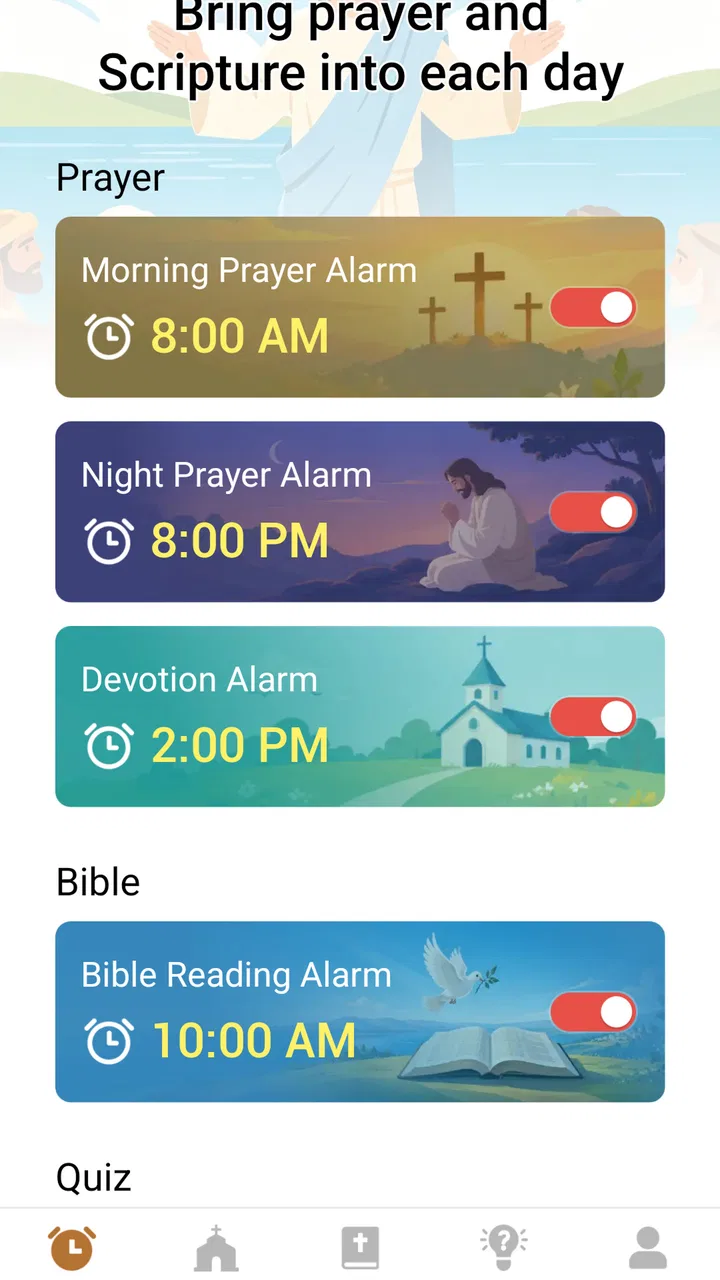
The Bible Launcher-KJV & Prayer app supports your prayer routine by offering a customizable prayer list where you can add personal prayers or requests. It also provides daily reminders and notifications to help maintain a consistent prayer schedule. Additionally, the app includes curated prayer guides to assist users in their spiritual practices.
Pros
- Easy access to KJV Bible text.
- Customizable prayer reminders.
- User-friendly interface design.
- Offline access to scripture.
- Quick search functionality.
Cons
- Contains in-app advertisements.
- Limited language support.
- No audio Bible feature.
- Requires regular updates.
- Limited customization options.

Holy Bible Daily Prayer
Gallery